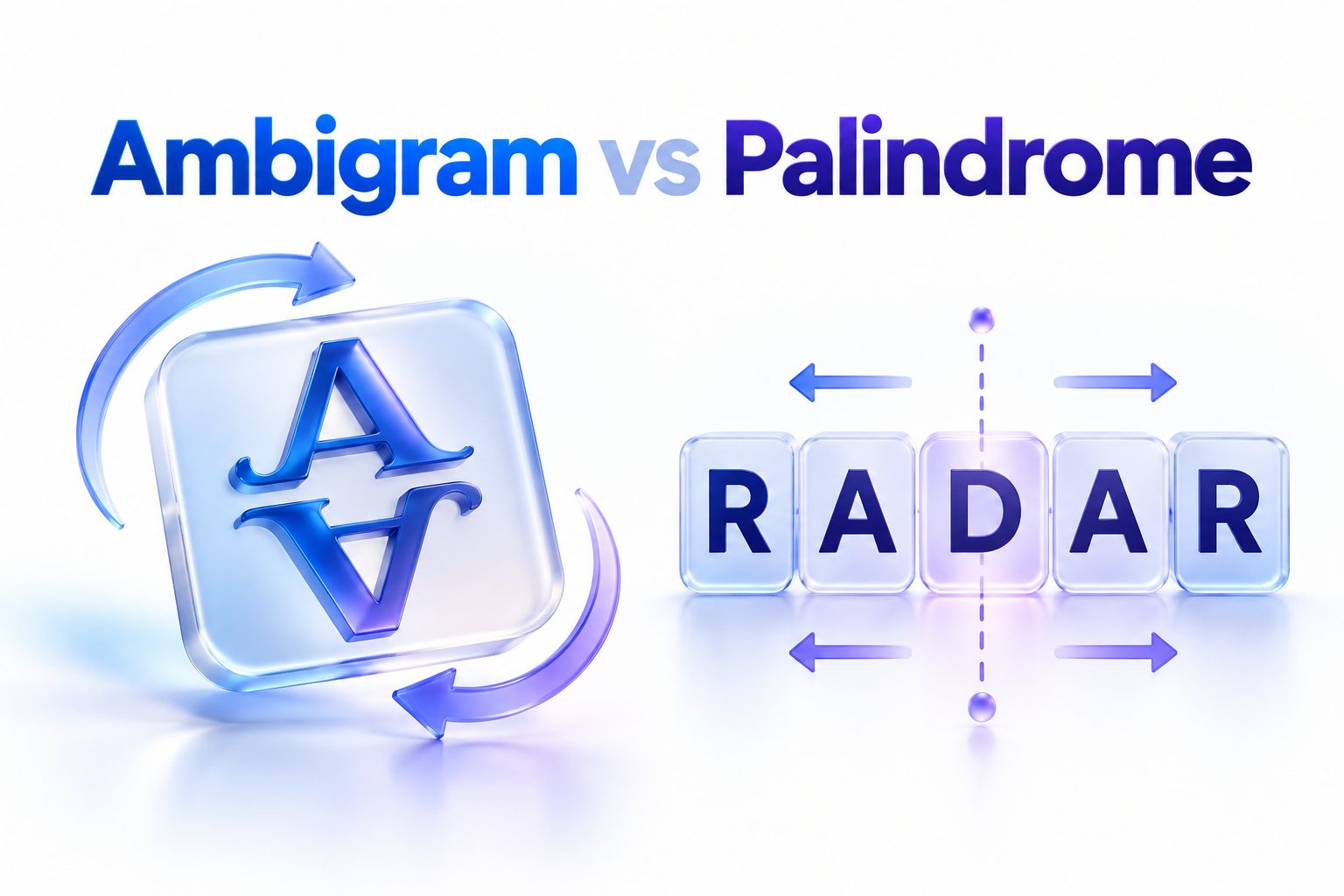
An ambigram and a palindrome both create symmetry, but they do it in completely different ways. The simplest explanation of ambigram vs palindrome is that an ambigram is a visual design, while a palindrome is a sequence of characters, words, or numbers. An ambigram remains readable after a transformation such as rotation or reflection. A palindrome reads the same forward and backward.
For example, “racecar” is a palindrome because reversing its letters produces the same word. A rotational ambigram might display a word so that it still appears unchanged—or reveals another word—when turned upside down. Its success depends on lettering, shapes, spacing, and viewing angle rather than spelling alone.
This distinction matters when evaluating logos, tattoos, word art, puzzles, and literary wordplay. Some creations can qualify as both, but one property does not automatically produce the other. Below, you will learn how each form works, how to identify them accurately, where they overlap, and how to create or choose one for a practical project.
Ambigram vs Palindrome at a Glance
The defining difference is the type of reversal involved. A palindrome uses an ordered sequence: reverse the characters, words, or digits, and the sequence remains identical. You can test it without changing the font, page orientation, or physical position of the text.
An ambigram depends on visual transformation. You may rotate the design 180 degrees, reflect it in a mirror, or change how you perceive the letterforms. The transformed image must still communicate an intended reading, although that reading does not always have to match the original word.
The Main Difference in One Example
Consider the word “LEVEL.” Its letters appear in the same order from left to right and right to left, so it is a palindrome. Yet ordinary typed text reading LEVEL will not necessarily remain legible when rotated upside down. Palindromic spelling does not make its typography an ambigram.
The reverse is also true. A designer can draw “hello” so it becomes “goodbye” after rotation. That image may be a successful two-word ambigram, but neither word is palindromic. The visual transformation works because of custom letterforms, not because the character sequence reverses identically.
Quick comparison:
- A palindrome is based on sequence.
- An ambigram is based on visual appearance.
- Palindromes can appear in plain text.
- Ambigrams usually require deliberate lettering or typography.
- A palindrome is tested by reversing its elements.
- An ambigram is tested by transforming and viewing its design.
- Both forms can express symmetry, repetition, duality, or hidden meaning.
What Makes a Palindrome
A palindrome is a word, phrase, number, or longer sequence that remains the same when its relevant elements are reversed. The term applies to more than individual words. Names, dates, sentences, and even structured passages can be palindromic when they follow a clearly defined reversal rule.
Common single-word examples include “civic,” “kayak,” “level,” “madam,” “radar,” “refer,” and “rotator.” Reading any of these words backward gives you the original spelling. No specialized font or graphic treatment is needed to demonstrate the property.
Normalization in Palindromic Phrases
Palindromic phrases are usually evaluated after capitalization, spaces, and punctuation have been removed. “Never odd or even” becomes “neveroddoreven,” which reads identically in both directions. This convention focuses the test on letters rather than ordinary sentence formatting.
The phrase “A man, a plan, a canal, Panama” is another familiar example. Its commas and spaces are not symmetrical, but its normalized letters are. A writer should state the chosen rules when symbols, accents, apostrophes, or word boundaries could affect the result.
Character Palindromes and Word Palindromes
Most familiar palindromes operate character by character. A word palindrome instead preserves the same sequence of whole words in reverse. For example, “fall leaves after leaves fall” has a mirrored word order, even though its complete string of letters is not identical backward.
This distinction is useful in poetry and constrained writing. A passage may be palindromic at the level of letters, words, lines, or even musical phrases. The relevant unit must be consistent throughout the test. Changing units midway creates an apparent symmetry rather than a valid palindrome.
Numbers and Dates
Numeric palindromes follow the same basic rule. Numbers such as 121, 1331, and 2002 remain unchanged when their digits are reversed. Leading zeros generally should not be added merely to make a number symmetrical, because they change how the number is conventionally written.
Certain dates can also appear palindromic, but date format matters. A date that works in month-day-year notation may fail in day-month-year notation. For more examples of reversed sequences and language patterns, see [Internal Link: Palindrome Examples and Wordplay].
What Makes an Ambigram
An ambigram is lettering designed to support more than one readable interpretation through a visual operation. The operation may involve rotation, reflection, perceptual switching, or a change in viewing direction. Letter anatomy and composition matter as much as the actual word being represented.
Many ambigrams use custom-drawn glyphs because ordinary typefaces are not flexible enough. A curve might serve as the top of one letter in the first orientation and the tail of another after rotation. Successful designs balance this dual function without becoming unreadable or overly decorative.
Rotational Ambigrams
A rotational ambigram is designed to be read after the artwork is turned, commonly by 180 degrees. It may show the same word in both orientations, known as a homogram, or transform into a different word, sometimes called a heterogram.
At 180 degrees, the left side moves to the right and the top becomes the bottom. Designers must therefore coordinate paired letters across the center of the word. A first letter may need to transform into the last letter, the second into the second-to-last, and so on.
Mirror Ambigrams
A mirror ambigram becomes readable when reflected across a vertical or horizontal axis. Some designs can be read both in their original form and in a mirror. Others use the mirror to reveal a second word or complete a message.
Vertical reflection reverses left and right without turning the design upside down. Horizontal reflection exchanges the top and bottom. These transformations create different constraints, so a design that succeeds as a rotational ambigram will not necessarily work as a mirror ambigram.
Figure-Ground and Perceptual Ambigrams
Not every ambigram requires physically moving the image. Figure-ground ambigrams use positive and negative space to display different readings. A letter belonging to one word may also define the empty space that forms another, much like an optical illusion.
Perceptual or oscillation ambigrams can be interpreted in more than one way from the same orientation. They depend on controlled ambiguity: the reader’s perception switches between two possible readings. Legibility is especially challenging because neither interpretation should completely overwhelm the other.
Important facts about ambigrams:
1. A transformed reading may be the same word or a different word.
2. Rotation by 180 degrees is common, but it is not the only valid transformation.
3. Ordinary fonts rarely produce polished ambigrams automatically.
4. Letter pairs often matter more than individual letters.
5. Context can help readers interpret highly stylized forms.
6. A readable word that merely looks decorative is not automatically an ambigram.
7. The design should be tested in every intended orientation.
How Ambigrams and Palindromes Create Symmetry
Both forms attract attention because they disrupt normal reading direction. Language usually moves in one expected direction, while images have a fixed upright position. Palindromes and ambigrams challenge those expectations by making reversal or transformation part of the experience.
Their symmetry is not identical, though. Palindromes have symbolic symmetry: the ordered characters or units match when reversed. Ambigrams have graphical symmetry or visual duality: shapes change position or interpretation while preserving a readable result.
Sequence Symmetry in Palindromes
A palindrome can be represented as a sequence in which the first element matches the last, the second matches the second-to-last, and so forth. In “radar,” the outer r letters match, the a letters match, and d forms the center.
This property remains stable across most fonts. Write “radar” in serif type, sans serif type, handwriting, or plain digital text, and it is still palindromic. Its identity depends on the order of the characters rather than their exact appearance.
Optical Symmetry in Ambigrams
Ambigrams are judged as images. The designer may stretch, merge, rotate, or simplify letters while preserving enough distinctive features for recognition. A design’s visual symmetry may be exact, approximate, or carefully disguised through ornamentation.
Because reading depends partly on perception, people may disagree about whether an ambitious design is successful. One viewer may recognize both readings immediately, while another sees only abstract shapes. That subjectivity does not affect basic palindrome testing, which usually produces a clear result.
Can a Word Be Both an Ambigram and a Palindrome
Yes, a word can be both, but it must independently pass both tests. Its spelling must read identically forward and backward, and its visual design must remain readable under the intended transformation. Meeting one condition gives no guarantee of meeting the other.
Words such as “NOON” and “SWIMS” are often discussed in ambigram contexts because certain uppercase letterforms can support rotational effects. “NOON” is also a palindrome. “SWIMS” is not a character palindrome, despite sometimes looking surprisingly similar after a 180-degree rotation in suitable lettering.
A practical classification table:
| Example | Palindrome | Ambigram | Reason |
| — | — | — | — |
| “racecar” in ordinary text | Yes | Usually no | The spelling reverses exactly, but the text does not rotate into a readable form |
| A custom rotational “racecar” design | Yes | Possibly | It qualifies as both if the artwork also survives rotation |
| A design changing “life” into “death” | No | Yes | The two readings come from visual transformation, not identical reversed spelling |
| 1221 in plain numerals | Yes | Not necessarily | The digits reverse identically, but the type may fail visually when transformed |
| A mirror-readable logo | Not necessarily | Yes | Reflection supplies the second reading |
| “Never odd or even” | Yes after normalization | Usually no | Its letters form a palindrome, while its ordinary layout lacks visual transformation |
How to Tell Which Form You Are Looking At
Start by separating the content from its appearance. Copy the letters or numbers into plain text and reverse their order. If the result matches under the stated rules, the sequence is palindromic. The original artwork is unnecessary for this part of the test.
Next, inspect the artwork itself. Apply the transformation claimed by the creator: rotate it, reflect it, or look for an alternate figure-ground reading. If meaningful text remains legible, the design may be an ambigram regardless of whether its underlying spelling is palindromic.
A Simple Identification Process
1. Write down the exact text represented in the original orientation.
2. Remove spaces, punctuation, or capitalization only if the palindrome rules allow normalization.
3. Reverse the relevant units, such as characters or words.
4. Compare the reversed sequence with the normalized original.
5. Return to the artwork and identify its intended visual transformation.
6. Rotate or reflect the entire design rather than reversing typed characters manually.
7. Record the text visible after transformation.
8. Classify the work as a palindrome, an ambigram, both, or neither.
Be cautious when a design works only because its creator explains it. Some artistic distortion is normal, but both intended readings should remain reasonably identifiable. A personal logo can tolerate more abstraction than a directional sign, where immediate recognition is essential.
Common Misconceptions About Ambigrams and Palindromes
One frequent mistake is assuming that a palindrome automatically looks symmetrical. The word “racecar” has sequence symmetry, but the shapes of r, a, c, and e do not create ordinary mirror or rotational symmetry. Linguistic reversal and visual reflection are separate properties.
Another misconception is that an ambigram must read the same word after transformation. Many excellent designs reveal a contrasting or related second word. A design switching between “teach” and “learn,” for example, can be an ambigram even though neither term is palindromic.
Letter Reversal Is Not the Same as Rotation
Reversing a word changes character order. Rotating a design moves every point in the image around a central point. A letter may become another letter under rotation, but it does not simply relocate to the opposite end of a line.
Likewise, mirroring is not identical to reading backward. A mirrored letter is visually reversed, while a backward sequence uses normally oriented letters in reverse order. This is why mirrored text can be difficult to read even when the underlying sequence is familiar.
Visual Symmetry Alone Is Not Enough
A decorative symbol may possess rotational symmetry without containing readable text. It is symmetrical artwork, not an ambigram. Ambigrams require linguistic interpretation: viewers must be able to identify letters, words, initials, or another deliberate textual reading.
Stylized lettering also does not qualify merely because several letters resemble one another. The claimed transformation must produce a coherent second reading. Ambigram is a functional description, not a general label for ornate calligraphy or unusually shaped typography.
Common classification mistakes:
- Calling every symmetrical logo an ambigram.
- Treating a mirrored word as a palindrome.
- Assuming any palindrome will work as a rotational tattoo.
- Ignoring spaces and punctuation without explaining the normalization rule.
- Confusing reversible word order with reversible character order.
- Judging an ambigram from only one orientation.
- Accepting a second reading that depends on mentally replacing several unclear letters.
Practical Uses for Palindromes
Palindromes are popular in word games, riddles, classroom exercises, programming challenges, poetry, and recreational mathematics. Their rules are easy to explain but can become difficult to satisfy as phrases grow longer, making them useful for teaching spelling, sequencing, and pattern recognition.
Writers also use them to reinforce themes of repetition, return, cycles, and reflection. A palindrome may serve as a title, hidden clue, character name, or structural device. Its effectiveness comes from the relationship between meaning and form rather than novelty alone.
Palindromes in Computing
Checking for palindromes is a common introductory programming exercise. A program normalizes input, reverses the resulting sequence, and compares it with the original. More advanced versions account for Unicode characters, punctuation, case folding, and different definitions of a textual unit.
The exercise demonstrates that technical rules must be explicit. Accented letters, combining marks, emoji sequences, and non-Latin scripts may not behave like simple English characters. What appears to be one symbol to a reader can contain multiple code points in software.
Palindromes in Naming and Branding
A palindromic name can be memorable because it has a compact, balanced rhythm. Yet spelling symmetry does not guarantee trademark availability, easy pronunciation, or a suitable brand meaning. Those issues should be assessed separately before a name is adopted.
Brands seeking a reversible visual identity may pair a palindromic name with custom lettering. That combination can create both verbal and graphical symmetry, but the logo still needs usability testing at small sizes, in monochrome, and across screens and printed materials.
Practical Uses for Ambigrams
Ambigrams appear in logos, book covers, album artwork, posters, jewelry, tattoos, monograms, and puzzle designs. They work especially well when the subject involves opposites, transformation, balance, dual identity, or a relationship between two people or concepts.
Unlike plain reversible text, an ambigram can reveal meaning through physical interaction. Turning a card, pendant, or book may expose the second reading. That moment gives the design narrative value, but only when the transformation is intentional and easy enough to recognize.
Ambigram Tattoos
Tattoos are one of the best-known ambigram applications. A single design might combine two names, a name and a value, or contrasting ideas. Rotational layouts are popular because the wearer or viewer can change the reading by changing the viewing direction.
Permanent placement raises practical concerns. The design should be tested at its actual size, viewed from relevant angles, and reviewed by the tattoo artist. Fine internal gaps may close as ink ages, while exaggerated flourishes can obscure letters. See [Internal Link: Typography Tattoo Design Tips] before finalizing intricate lettering.
Logos and Identity Systems
An ambigram logo can communicate flexibility or duality in a compact image. It may also create a memorable reveal during animation, packaging rotation, or environmental display. The strongest examples connect the transformation to the organization’s name or purpose.
Still, cleverness cannot replace clarity. A logo must function on mobile screens, signs, invoices, and accessible digital interfaces. A simplified companion wordmark may be necessary when the ambigram becomes too intricate at small sizes.
Best-use checklist:
□ The transformation supports the project’s meaning.
□ Both readings are identifiable without lengthy explanation.
□ The design works at the smallest required size.
□ Letterforms remain distinct in monochrome.
□ The intended orientation is clear when clarity matters.
□ Decorative details do not overwhelm the text.
□ The design has been tested with people unfamiliar with it.
□ Tattoo or production constraints have been reviewed before approval.
Creating a Palindrome
Creating a single-word palindrome usually begins with known symmetrical structures. You can place a letter or short sequence on one side, mirror its order on the other, and optionally add a central character. The challenge is producing a real word or meaningful phrase rather than a random pattern.
Longer phrases require more flexibility. Writers often begin with a short palindromic core, add matching letters to opposite ends, and adjust spacing afterward. Since normalization may ignore punctuation and spaces, the final sentence can use word boundaries that are not themselves symmetrical.
A Practical Writing Method
1. Decide whether the result will reverse by letters, words, or lines.
2. Establish rules for spaces, punctuation, capitalization, and accents.
3. Choose a central word, letter, or short palindromic sequence.
4. Add matching characters or units to both sides in reverse order.
5. Search for natural word breaks and grammatical possibilities.
6. Read the result for meaning, not just technical correctness.
7. Normalize and reverse the finished text to verify it.
Forced grammar is the main weakness in long palindromes. A technically valid sentence may sound unnatural because the reversal constraint dominates the writing. Short, memorable phrases often provide more value than long constructions that require extensive explanation.
Designing an Ambigram
Ambigram creation begins with the transformation, not the decoration. Decide whether the design will rotate, reflect, or switch through negative space. Then write down the reading required in each state. This determines which letters must correspond with one another.
For a 180-degree rotational design, pair the first letter of the initial reading with the last letter of the transformed reading. Continue inward until every position has a partner. Sketch paired forms before trying to draw the complete word.
Building Letter Pairs
Compatible pairs may share stems, bowls, diagonals, or curves. An m might suggest a w after rotation, while other pairings require custom ligatures or ornamental strokes. The goal is not typographic purity; it is a controlled compromise that preserves recognizable cues in both orientations.
Test the most difficult pair first. If one combination cannot be made legible, polishing the easy letters wastes time. Designers frequently adjust capitalization, script style, stroke contrast, and spacing to increase the number of workable pairings.
Refining the Full Composition
Once each pair works alone, assemble the word and inspect its rhythm. Letters that are readable in isolation can collide or create misleading shapes when placed together. Negative spaces and connecting strokes need as much attention as the main letterforms.
Rotate or reflect the artwork repeatedly during refinement. Do not perfect one orientation while leaving the second until the end. Ambigram design is an alternating process in which every change must be evaluated from both intended views.
Quick design tips:
- Start with pencil sketches or simple vector paths rather than detailed effects.
- Use consistent stroke weight to make hybrid letters feel intentional.
- Preserve the most distinctive feature of each letter.
- Test with unfamiliar readers instead of relying only on your own perception.
- Reduce flourishes when they introduce false letter shapes.
- Print the design at actual size before using it for a tattoo or product.
- Keep an ordinary wordmark available when instant readability is required.
Limitations and Edge Cases
Palindrome rules can become ambiguous when language contains punctuation, diacritics, ligatures, or characters represented in multiple technical forms. Word-level palindromes also depend on tokenization: readers must agree about what counts as a separate word. Clear rules prevent disagreements about otherwise valid examples.
Ambigrams involve a different kind of ambiguity. Their success depends partly on typography, cultural familiarity, visual acuity, and context. A Latin-letter design may not transfer to another script, while an ornate blackletter form may confuse readers who rarely encounter that style.
Approximate and Natural Ambigrams
Some letter and number combinations look reversible in particular fonts without being custom-designed. Calculator words are a related form of visual play: digits resemble letters when a calculator is rotated. These may be treated as ambigrammatic, although their interpretation relies on substitution between numerals and letters.
“Natural ambigram” is often used for a word that gains rotational or reflective readability from existing letter shapes. The result may work in one typeface and fail in another. Font dependence is therefore central to the claim, unlike a palindrome’s font-independent sequence.
Context and Readability
People infer words from partial information, so context can rescue ambiguous lettering. A viewer expecting a person’s name may recognize it from only a few clear letter cues. That does not mean the same design will remain readable when isolated or shown to another audience.
For high-stakes uses such as navigation, safety information, legal names, or accessibility labels, visual wordplay should remain secondary. Supply conventional text where necessary. Ambiguity can be appealing in art, but it is a liability when readers must act quickly or accurately.
Choosing Between an Ambigram and a Palindrome
Choose a palindrome when the language pattern itself matters. It is well suited to wordplay, riddles, constrained writing, memorable names, coding exercises, and themes of return. It also works in plain text, making it easy to reproduce across formats.
Choose an ambigram when physical or visual transformation is part of the message. It suits a logo, tattoo, poster, cover, monogram, or object that viewers can rotate or reflect. Expect more design work and more variation in how audiences perceive the result.
Do and don’t guidance:
- Do choose a palindrome for a verifiable spelling or sequence puzzle.
- Don’t assume palindromic spelling will create an attractive reversible logo.
- Do choose an ambigram when two orientations or meanings add genuine value.
- Don’t sacrifice essential readability merely to preserve the visual trick.
- Do test palindrome rules with normalized plain text.
- Don’t test an ambigram by reversing character order alone.
- Do involve a lettering artist for permanent or commercial applications.
- Don’t rely solely on an automated ambigram generator for final artwork.
Conclusion
The clearest way to compare ambigram vs palindrome is to ask what is being transformed. A palindrome survives the reversal of its sequence. Its letters, words, or digits appear in the same order when read backward according to a defined set of rules. An ambigram survives a visual transformation, such as rotation, reflection, or a shift between positive and negative space.
Neither form automatically creates the other. A palindromic word may look unreadable upside down, while a rotational design can reveal two different words that are not palindromes. A creation qualifies as both only when its sequence reverses correctly and its lettering works under the intended visual operation.
For practical evaluation, separate the text from the artwork. Reverse the normalized sequence to test the palindrome, then transform the complete image to test the ambigram. When creating one, prioritize meaning and readability over technical cleverness. The best examples do more than pass a test: their symmetry supports the idea, name, story, or object in which they appear.
Frequently Asked Questions
Is every palindrome an ambigram?
No. A palindrome preserves its character or word sequence when reversed, but an ambigram must remain readable after a visual transformation. Ordinary palindromic text usually does not work when rotated or reflected.
Can an ambigram show two different words?
Yes. A heterogram-style ambigram can display one word in its original orientation and another after rotation or reflection. The words do not need to be palindromes, although their letterforms must support the transformation.
Is a mirrored word a palindrome?
Not necessarily. Mirroring reverses the visual shapes and positions of letters, while a palindrome reverses their sequence using normally readable characters. A mirrored word qualifies only if it independently meets the relevant palindrome rule.
Can numbers be ambigrams and palindromes?
Yes. A number can be palindromic when its digits reverse identically and ambigrammatic when its printed forms remain meaningful after rotation or reflection. Typeface choice is crucial for the visual property.
Do ambigram generators create reliable designs?
They can provide rough ideas, but results often need manual refinement. Automated tools may force unclear letter combinations, inconsistent spacing, or excessive ornamentation. Important logos and tattoos should be reviewed and adjusted by an experienced lettering artist.