
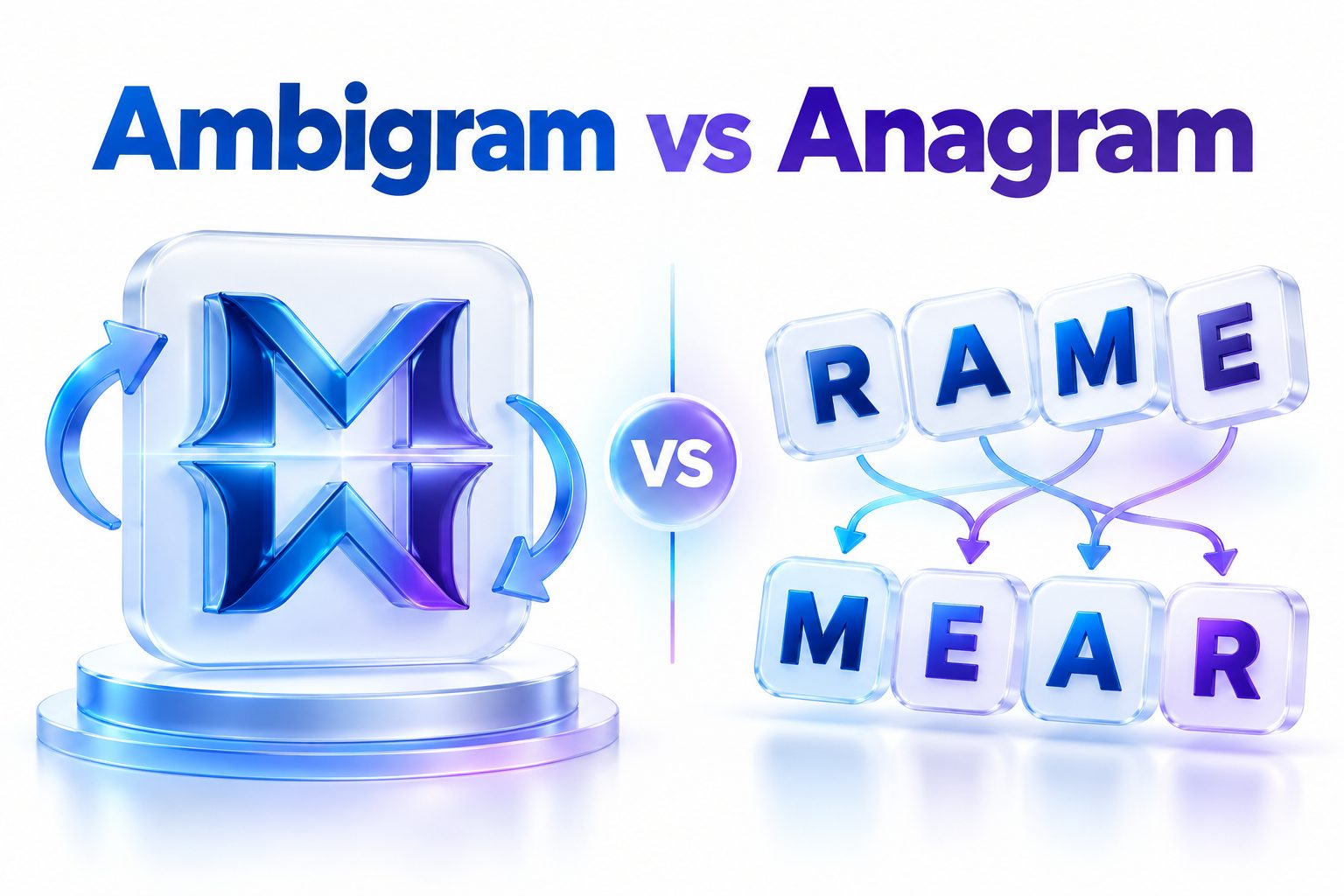
The terms ambigram and anagram sound similar, and both involve words, but they describe entirely different forms of wordplay. An ambigram is a visual design that remains readable or reveals another message when it is rotated, reflected, or viewed from a different direction. An anagram is created by rearranging every letter in a word or phrase to form a new word or phrase.
That distinction is the short answer to ambigram vs anagram. One depends primarily on typography, symmetry, and perspective; the other depends on spelling, vocabulary, and letter arrangement. For example, a carefully drawn version of “SWIMS” may work as a rotational ambigram, while “listen” can be rearranged to make the anagram “silent.”
The two concepts can overlap in an especially clever design, but neither one automatically qualifies as the other. This article explains how each form works, how to identify and create them, which rules matter, and where common examples can be misleading. You will also learn about related terms such as palindromes, semordnilaps, and isograms, making it easier to classify almost any piece of verbal or visual wordplay correctly.
Ambigram vs Anagram at a Glance
An ambigram is based on how lettering looks. Its meaning or readability changes—or stays the same—when the design undergoes a visual transformation. Rotation is the best-known transformation, but ambigrams can also use reflection, changes in viewing direction, negative space, or shifts in visual interpretation.
An anagram is based on which letters are present. The original word’s letters must be rearranged to produce a different word or phrase, with every letter used exactly as often as it originally appears. Typeface, capitalization, color, and viewing angle have no effect on whether the result is valid.
Comparison Table
Feature | Ambigram | Anagram
— | — | —
Primary element | Letterform and visual design | Letter order
Main technique | Rotation, reflection, perspective, or visual reinterpretation | Rearranging letters
Typical medium | Logo, tattoo, illustration, lettering, artwork | Word puzzle, clue, name, phrase
Needs custom typography | Often | No
Must reuse every letter | Not as a defining rule | Yes
May show the same word twice | Yes | Usually forms a different word or phrase
Depends on viewing angle | Often | No
Example | A “NOON” design readable after a half-turn | “earth” rearranged as “heart”
Core skill | Lettering and spatial design | Spelling and vocabulary
What Is an Ambigram
An ambigram is a word, phrase, symbol, or visual composition designed to support more than one reading. The second reading appears after a defined visual change, such as turning the design upside down, looking at it in a mirror, or shifting attention between foreground and background shapes.
Ambigrams are not limited to decorative lettering. They are pieces of visual problem-solving. A designer may alter strokes, merge neighboring letters, stretch curves, or use ornamental marks to make one shape perform two jobs. Successful designs balance legibility with the transformation they are meant to demonstrate.
Rotational Ambigrams
A rotational ambigram becomes readable after it is turned through a specified angle. The most familiar type uses 180-degree rotational symmetry, meaning the viewer turns the design upside down. The transformed image may repeat the original word or display a different one.
Some ordinary characters already have useful rotational qualities. Depending on the font, letters such as H, I, N, O, S, X, and Z may survive a half-turn reasonably well. Most words still require customized lettering because the first character must visually correspond to the last, the second to the second-to-last, and so on.
Mirror and Reflection Ambigrams
A mirror ambigram can be read in a reflection or across a vertical or horizontal axis. In a vertical reflection design, the left and right sides must cooperate. A horizontal reflection places similar demands on the upper and lower parts of each letter.
Mirror ambigrams are often used in signs, paired names, or symbolic artwork. Ordinary fonts rarely create a convincing result because most letters become backward when reflected. Designers compensate by constructing hybrid letterforms that look like one character directly and another in the mirror.
Figure-Ground and Perceptual Ambigrams
Some ambigrams do not need physical movement. Instead, the viewer changes how the same arrangement is interpreted. One reading may appear in the dark foreground while another emerges from the negative space. Other designs use ambiguous strokes that the eye can group in two different ways.
These versions are closely related to optical illusions. They depend on perception rather than strict geometric symmetry, so viewers may notice one message immediately and need time to see the other. Strong contrast and deliberate spacing are especially important in this style.
What Is an Anagram
An anagram is a word or phrase formed by rearranging all the letters in another word or phrase. “Save” and “vase” are anagrams because both contain one S, one A, one V, and one E. The order changes, but the complete letter inventory remains identical.
Spaces, punctuation, and capitalization are usually ignored. Letters are not. If the source contains two instances of a letter, the result must also contain two. Adding, removing, replacing, or repeating a character creates a related-looking phrase, but not a strict anagram.
Word Anagrams
A word anagram rearranges a single word into another recognized word. Familiar examples include “angel” and “glean,” “inch” and “chin,” and “night” and “thing.” Short examples are easy to verify, although they may be harder to find because fewer letters permit fewer combinations.
A source word can have several valid results. “Notes,” for instance, can become “stone,” “tones,” or “onset.” Which results count may depend on the dictionary being used, particularly when puzzles allow regional spellings, archaic terms, abbreviations, or proper nouns.
Phrase Anagrams
Phrase anagrams rearrange letters across several words. Because spaces are normally ignored, the new phrase can divide the letters differently. Longer sources offer more possible arrangements, but producing a natural, meaningful sentence is considerably harder than generating a random string of valid words.
Good phrase anagrams often comment on the original subject. This added connection is sometimes called aptness. A technically correct result may be forgettable, while an apt result feels intentional because its meaning relates humorously, descriptively, or ironically to the source.
Essential Anagram Rules
Use this checklist to test a proposed anagram:
- Remove spaces, punctuation, hyphens, and capitalization unless a puzzle specifies different rules.
- Count every occurrence of every letter in the original.
- Count the letters in the proposed result.
- Confirm that the two frequency counts match exactly.
- Check that the resulting words are permitted by the relevant dictionary or puzzle rules.
- Do not treat a synonym as an anagram unless its letters also match.
- Do not overlook repeated letters, which cause many false matches.
- State clearly when accents, abbreviations, or proper nouns are being allowed.
The Key Difference Between Ambigrams and Anagrams
The central difference is the kind of transformation involved. An ambigram transforms the viewer’s relationship to a design: the object is rotated, reflected, or reinterpreted. An anagram transforms the sequence of letters: the characters are reordered while their quantities remain fixed.
That difference also determines how each creation should be judged. An anagram can be checked objectively by comparing letter counts. Ambigram quality is more visual and partly subjective. A design may satisfy its intended transformation yet remain difficult to read, especially without guidance.
Visual Form Versus Letter Inventory
In an ambigram, an individual mark may deliberately resemble more than one letter. A shape could read as an M in one direction and a W after rotation. The physical mark stays in place, but its apparent identity changes with orientation or context.
In an anagram, each letter retains its identity. An M cannot stand in for a W, and decorative styling does not alter the letter count. The letters merely move to new positions, whether physically in a puzzle or conceptually when a solver rearranges them.
Same Medium, Different Mechanism
Both forms can appear in logos, book covers, puzzles, and tattoo designs, which helps explain why people confuse them. Their shared medium does not make them equivalent. A tattoo showing a name upside down is using ambigram design, even if no letters were rearranged.
Likewise, a logo that scrambles a company name into another phrase is an anagram even when the lettering looks artistic. Classification follows the mechanism, not the setting. Ask what must change to reveal the second reading: orientation and perception indicate an ambigram; letter order indicates an anagram.
Examples That Make the Distinction Clear
“Listen” and “silent” offer a clean anagram example. Both use exactly the same six letters, but their visual appearance is irrelevant. You could type them in any legible font, write them on separate cards, or say them aloud. The anagram relationship would remain intact.
A rotational design of “NOON” demonstrates the ambigram idea. With suitable letterforms, the composition may still read as “NOON” after a 180-degree turn. Its success depends on the actual drawing. Typing NOON in an arbitrary font does not guarantee a functional ambigram.
Practical Classification Examples
- “Dormitory” rearranged into “dirty room” is an anagram because the normalized letter counts match.
- A logo that reads “up” normally and “down” after rotation is an ambigram because orientation reveals the alternate message.
- “Racecar” is a palindrome because it reads the same backward, not automatically an ambigram or anagram.
- A mirrored word that becomes legible only in reflection is a mirror ambigram.
- Two phrases with similar meanings but different letters are neither anagrams nor ambigrams.
- A custom design that rotates into a letter-perfect anagram of its first message can be both.
- A word printed upside down without remaining readable is not an ambigram merely because it was rotated.
How to Create an Anagram
Start by normalizing the source. Write its letters in lowercase, remove spaces and punctuation, and sort the characters alphabetically. A source such as “the eyes” becomes “eehsty.” This sorted form acts as an inventory that any valid result must reproduce exactly.
Next, search for useful word fragments rather than shuffling characters randomly. Longer or distinctive words usually narrow the possibilities fastest. Remove a candidate word’s letters from the inventory, then build with what remains. Meaningful results require both accurate bookkeeping and editorial judgment.
A Reliable Step-by-Step Method
1. Write the exact source word or phrase.
2. Remove spaces, punctuation, and capitalization.
3. Create a frequency count for every letter.
4. Identify uncommon letters or promising prefixes and suffixes.
5. Test a strong candidate word and subtract its letters.
6. Arrange the remaining letters into one or more valid words.
7. Compare the final letter count with the original.
8. Read the result aloud and revise awkward wording.
9. Prefer an apt or memorable result when several valid options exist.
An anagram solver can generate candidates quickly, especially for long phrases. Treat its output as raw material rather than a finished answer. Automated lists often contain obscure words, forced grammar, or combinations that satisfy letter counts without communicating anything worthwhile.
How to Design an Ambigram
Begin with the intended transformation. Decide whether the design should rotate 180 degrees, reflect in a mirror, exchange two different words, or reveal a second reading through negative space. That decision governs the letter pairings and prevents aimless sketching.
Write the first message forward and the transformed message in the order it must occupy after the change. In a half-turn design, outside letters generally pair with one another: the first character must work with the last transformed character, then the second with the next-to-last.
Building the Letter Pairs
Sketch paired characters as shared shapes. Look for compatible structural features, such as a vertical stem, loop, diagonal, or open bowl. A lowercase style, script hand, or ornamental display alphabet may provide flexibility that rigid uppercase block letters do not.
Do not perfect one letter before considering its neighbors. Ambigrams often rely on ligatures, overlapping strokes, and shared flourishes across several characters. The word should be developed as a composition rather than a row of isolated glyphs.
Testing and Refinement
Rotate or reflect the sketch frequently during development. A design that looks convincing in its original orientation may collapse after transformation. Testing at small sizes is also useful because excessive decorative detail can conceal weak letter construction instead of solving it.
Show the result to someone who has not seen the intended words. Ask what they read in each orientation without offering clues. If the reader consistently guesses incorrectly, revise the ambiguous strokes, spacing, or balance. Readability matters more than perfect mathematical symmetry.
Ambigram Design Checklist
- Define the transformation before drawing.
- Confirm the exact word or pair of words.
- Map which letters must correspond after transformation.
- Choose a flexible lettering style.
- Sketch structural letter pairs first.
- Develop neighboring letters together.
- Test both readings throughout the process.
- Remove decoration that interferes with recognition.
- Check legibility at the intended display size.
- Use an uninformed reader for the final test.
For readers interested in the broader craft behind custom lettering, [Internal Link: Typography and Lettering Basics] can provide useful context on stroke weight, spacing, contrast, and visual hierarchy.
Can an Ambigram Also Be an Anagram
Yes, one design can combine both concepts, but it must satisfy each definition independently. The two readings must contain exactly the same letters in a different order to qualify as anagrams, while the artwork must reveal those readings through rotation, reflection, or another visual transformation to qualify as an ambigram.
This overlap is relatively rare because it imposes two sets of constraints. The designer must find a valid anagram pair with suitable meaning, then create compatible letterforms for the required transformation. A visual word pair with different letter inventories may be an excellent ambigram but cannot be an anagram.
A Simple Validation Test
To determine whether a creation qualifies as both, run two
- Visual test: Does the alternate message become readable through a defined change in orientation, reflection, or perception?
- Letter test: After removing spaces, punctuation, and capitalization, do both messages contain identical letter counts?
- Independence test: Would the phrase pair remain anagrams in plain text?
- Design test: Would the artwork still demonstrate an ambigram transformation even without explaining the letter relationship?
Passing only the visual test means the work is an ambigram. Passing only the letter test means the words are anagrams. Passing both makes the creation a combined ambigram-anagram.
Ambigrams, Anagrams, and Related Wordplay
Palindromes are often mixed up with both terms. A palindrome reads the same forward and backward, as in “level” or “never odd or even” when spaces are ignored. This is a sequence property, not a visual transformation, so a palindrome is not automatically an ambigram.
Other nearby terms describe still different relationships. Learning them makes classification easier and helps puzzle writers give precise instructions. The boundaries are especially useful when a word seems to perform a trick but does not meet the strict definition of an anagram.
Palindromes
A palindrome preserves the same character sequence when reversed. No letters are rearranged into a new order by choice; reading backward simply produces the original sequence. “Civic” and “refer” are straightforward examples.
Some palindromic words are convenient raw material for ambigrams because their outer letters already pair symmetrically. Still, standard typography may not survive rotation or reflection. Palindromic spelling helps with structure but does not replace intentional visual design.
Semordnilaps
A semordnilap forms a different word when its letters are read backward. “Stressed” becomes “desserts,” and “drawer” becomes “reward.” Unlike a general anagram, the new order is specifically the exact reverse of the original.
Every semordnilap pair is also an anagram pair because it uses the same letters. Not every anagram is a semordnilap, since most anagrams use some rearrangement other than reversal. The term itself is “palindromes” spelled backward.
Isograms and Pangrams
An isogram contains no repeated letters, such as “lumberjack.” This property can simplify anagram checking because every character appears once, though it does not guarantee that useful rearrangements exist. Isograms concern repetition, not direction or visual form.
A pangram uses every letter of an alphabet, ideally at least once. Pangrams are known for sentences such as typing exercises. They may contain anagrams within them, but their defining goal is alphabet coverage rather than rearrangement.
Common Mistakes When Comparing the Two
One frequent mistake is calling any decorative, symmetrical word an ambigram. Visual balance alone is insufficient. The composition must support another readable interpretation after the intended transformation. A symmetrical border around ordinary text does not turn that text into an ambigram.
Another error is accepting approximate anagrams. Matching most letters, substituting a similar sound, or adding a convenient character breaks the strict relationship. Online examples are sometimes repeated without verification, so checking letter frequencies is more dependable than trusting a clever-looking phrase.
Do and Don’t List
Do:
- Identify whether the effect depends on visual form or letter order.
- Verify anagrams with exact character counts.
- Test ambigrams in every intended orientation.
- Ignore spaces and capitalization only when the stated rules permit it.
- Consider legibility, not just symmetry, when judging visual work.
Don’t:
- Assume every palindrome is an ambigram.
- Count a word pair as an anagram because the meanings are related.
- Treat upside-down ordinary text as a successful ambigram.
- Add or remove letters to make an anagram read better.
- Assume decorative typography changes an anagram’s validity.
For more distinctions between reversal, rearrangement, and repetition, see [Internal Link: Types of Wordplay and Word Puzzles].
Where Ambigrams and Anagrams Are Used
Ambigrams appear frequently in logos, book artwork, tattoos, monograms, posters, and album graphics. They suit contexts where transformation supports the message. A brand built around duality, reflection, balance, or change may use an ambigram to express its identity through the lettering itself.
Anagrams are common in crossword clues, escape-room puzzles, word games, pen names, fictional identities, and educational activities. They test vocabulary and pattern recognition. Writers also use them to hide names or create thematic connections between a character and an alternate identity.
Choosing the Right Form
Choose an ambigram when the physical presentation matters and the audience will see the design in more than one orientation. It is best suited to a short, visually adaptable word or a pair of similarly structured words. Long phrases increase both design difficulty and reading effort.
Choose an anagram when the goal is a verbal puzzle, concealed message, or meaningful rearrangement. Longer sources can yield richer results, although they require careful verification. If the intended effect must work when spoken or typed in plain text, an anagram is the more appropriate form.
Important Limitations
Not every word can become a clear ambigram. Difficult letter pairings, uneven word lengths, and strict brand fonts may force compromises. An ambigram generator can offer a quick visual concept, but automated results often depend on generic symbol substitutions and may need substantial manual refinement.
Not every source produces an elegant anagram either. A mathematically valid set of words can still be unnatural, obscure, or meaningless. Available results depend on source length, repeated letters, language, and permitted vocabulary. Accuracy establishes validity; good phrasing establishes quality.
How to Evaluate Quality
A high-quality ambigram should be readable in every intended state, balanced as a composition, and consistent in style. Some ambiguity is expected because the letterforms serve multiple roles, but the viewer should not need a detailed explanation to decipher each reading.
A high-quality anagram must first be exact. Beyond that, it should use recognizable language and ideally relate to the original expression. Concise grammar, a surprising connection, or a witty contrast turns a technical rearrangement into memorable wordplay.
Quick Evaluation Tips
- Read an ambigram at its final intended size, not only as a large sketch.
- View it quickly to test first impressions, then inspect individual letterforms.
- Rotate or reflect the physical design rather than imagining the result.
- Ask several readers to identify both messages independently.
- Verify an anagram by sorting both letter strings alphabetically.
- Reject results that rely on unexplained abbreviations or misspellings.
- Favor natural phrasing over obscure dictionary combinations.
- Judge hybrid designs against both standards, not a relaxed mixture of them.
Conclusion
The distinction comes down to what changes. An ambigram uses visual form, allowing lettering to retain or alter its message when rotated, reflected, or interpreted differently. An anagram uses the same letters in a new order, and its validity depends on exact letter counts rather than appearance.
When judging ambigram vs anagram examples, ask one practical question first: does the effect come from changing the view or rearranging the characters? A changed view points to an ambigram. Rearranged characters point to an anagram. If a creation does both and passes each test separately, it can legitimately belong to both categories.
Accuracy matters in either craft. Ambigrams should be tested for readability in all intended orientations, while anagrams should be checked character by character. Palindromes, semordnilaps, isograms, and other forms may share certain features, but they have their own rules. Keeping those rules separate makes it easier to solve puzzles, assess designs, and create wordplay that is clever for the right reasons.
Frequently Asked Questions
Can a word be both an ambigram and an anagram?
Yes. A design qualifies as both when its transformed reading uses an exact rearrangement of the original letters. It must independently pass the visual ambigram test and the matching-letter-count anagram test.
Is a palindrome the same as an ambigram?
No. A palindrome reads identically forward and backward, while an ambigram depends on visual transformation or perception. A palindromic word can be designed as an ambigram, but its spelling alone does not make it one.
Does an anagram have to use every letter?
Yes. A strict anagram uses every original letter exactly once for each time it appears. Spaces, punctuation, and capitalization are commonly ignored, but adding, deleting, or substituting letters makes the result invalid.
Do ambigrams always work upside down?
No. A 180-degree rotational ambigram works upside down, but other forms use mirrors, horizontal reflection, negative space, or perceptual shifts. The defining feature is an alternate readable interpretation produced through a planned visual transformation.
Are ambigram generators accurate?
They can produce useful starting points, but quality varies. Automated designs often use a limited alphabet and may sacrifice readability for symmetry. Custom refinement and testing with unfamiliar readers are usually needed for professional results.